- Details
- Category: About ASATR
Turkey, officially the Republic of Turkey, is a contiguous transcontinental parliamentary republic largely located in Western Asia with the portion of Eastern Thrace in Southeastern Europe. Turkey is bordered by eight countries: Bulgaria to the northwest; Greece to the west; Georgia to the northeast; Armenia, Iran and the Azerbaijani exclave of Nakhchivan to the east; and Iraq and Syria to the southeast. The Mediterranean Sea is to the south; the Aegean Sea to the west; and the Black Sea to the north. The Sea of Marmara, the Bosphorus and the Dardanelles (which together form the Turkish Straits) demarcate the boundary between Thrace and Anatolia; they also separate Europe and Asia. Turkey's location at the crossroads of Europe and Asia makes it a country of significant geostrategic importance.
Turkey has been inhabited since the paleolithic age, including various ancient Anatolian civilisations, Aeolian and Ionian Greeks, Thracians, and Persians. After Alexander the Great's conquest, the area was Hellenized, which continued with the Roman rule and the transition into the Byzantine Empire. The Seljuk Turks began migrating into the area in the 11th century, starting the process of Turkification, which was greatly accelerated by the Seljuk victory over the Byzantines at the Battle of Manzikert in 1071. The Seljuk Sultanate of Rûm ruled Anatolia until the Mongol invasion in 1243, upon which it disintegrated into several small Turkish beyliks.
Starting from the late 13th century, the Ottomans united Anatolia and created an empire encompassing much of Southeastern Europe, Western Asia and North Africa, becoming a major power in Eurasia and Africa during the early modern period. The empire reached the peak of its power between the 15th and 17th centuries, especially during the reign of Suleiman the Magnificent (r. 1520–1566). After the second Ottoman siege of Vienna in 1683 and the end of the Great Turkish War in 1699, the Ottoman Empire entered a long period of decline. The Tanzimat reforms of the 19th century, which aimed to modernise the Ottoman state, proved to be inadequate in most fields, and failed to stop the dissolution of the empire. The Ottoman Empire entered World War I (1914–1918) on the side of the Central Powers and was ultimately defeated. During the war, major atrocities were committed by the Ottoman government against the Armenians, Assyrians and Pontic Greeks.
Following WWI, the huge conglomeration of territories and peoples that formerly comprised the Ottoman Empire was divided into several new states. The Turkish War of Independence (1919–1922), initiated by Mustafa Kemal Atatürk and his colleagues in Anatolia, resulted in the establishment of the modern Republic of Turkey in 1923, with Atatürk as its first president.
Turkey is a democratic, secular, unitary, constitutional republic with a diverse cultural heritage. The country's official language is Turkish, a Turkic language spoken natively by approximately 85% of the population. About 70-75% of the population are ethnic Turks and about 25-30% of the population consists of legally recognised (Armenians, Greeks and Jews) and unrecognised (Kurds, Circassians, Albanians, Bosniaks, Georgians, etc.) minorities. The vast majority of the population is Muslim. Turkey is a member of the UN, NATO, OECD, OSCE, OIC and the G-20. After becoming one of the first members of the Council of Europe in 1949, Turkey became an associate member of the EEC in 1963, joined the EU Customs Union in 1995 and started full membership negotiations with the European Union in 2005. Turkey's growing economy and diplomatic initiatives have led to its recognition as a regional power.
- Details
- Category: About ASATR
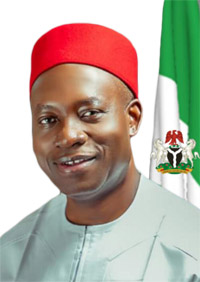
Charles Chukwuma Soludo, CFR (born 28 July 1960) is a Nigerian politician and economics professor who serves as the fifth democratic Governor of Anambra State since 17 March 2022. On 9 November 2021, Soludo, representing the All Progressives Grand Alliance, was declared winner of the 2021 Anambra State gubernatorial election, defeating his closest rivals from the PDP and APC, Valentine Ozigbo and Emmanuel Nnamdi Uba, respectively. Soludo is a former governor and chairman of the board of directors of the Central Bank of Nigeria (CBN). He was appointed as the bank's governor on 29 May 2004. He is also a member of the British Department for International Development's International Advisory Group and member of President Buhari's Presidential Economic Advisory Committee.
Academia
Soludo has been a visiting scholar at the International Monetary Fund, the University of Cambridge, the Brookings Institution, the University of Warwick, and the University of Oxford as well as a visiting professor at Swarthmore College (USA). He has also worked as a consultant for a number of international organizations, including The World Bank, the United Nations Economic Commission for Africa, and the United Nations Development Programme. Soludo is a core professional in the business of macroeconomics. He obtained his three degrees and then professorship at the University of Nigeria in Nsukka, Enugu State. Soludo graduated with a First Class Honors degree in 1984, an MSc Economics in 1987, and a PhD in 1989, winning prizes for the best student at all three levels.
Chukwuma has been trained and involved in research, teaching, and auditing in such disciplines as multi-country macro-econometric modelling, techniques of computable general equilibrium modelling, survey methodology, and panel data econometrics, among others. He studied and taught these courses at many universities, including Oxford, Cambridge, and Warwick. Soludo has co-authored, co-edited, and authored a number of books on this subject matter.
In 1998, Soludo was appointed to the position of professor of economics at the University of Nigeria; the next year he became a visiting professor at Swarthmore College in Swarthmore, Pennsylvania, USA.
Government
Soludo joined the federal government in 2003 and served as chief economic adviser to President Olusegun Obasanjo. Prior to his May 2004 appointment to the CBN's chairmanship, he was the Chief Executive of the National Planning Commission of Nigeria. In January 2008, in a speech to the Nigerian Economic Society, he predicted consolidation in the private banking industry, saying "By the end of 2008, there will be fewer banks than there are today. The restructuring of the banking industry has been attracting funds from local and foreign investors, which have increased banks' ability to lend to customers". Soludo hopes to see Nigeria become Africa's financial hub, and considers microfinance important to the federal government's economic policies.
Appointment as a member of the Economic Advisory Council (EAC)
On 16 September 2019, the President of Nigeria, Muhammadu Buhari, appointed Soludo as a member of a newly formed 8-member Economic Advisory Council (EAC) which would report directly to the President on issues related to national economic policies.
Politics
In September 2009, Soludo announced his aspiration for the seat of the Governor of Anambra State, in the south-eastern Nigerian state's election of 9 February 2010. On 9 October 2009, the People's Democratic Party (PDP) chose Soludo as their consensus candidate for the position from a field of 47 candidates, after repeated attempts to hold elective primaries were stalled by court injunctions. However, his nomination was contested by 23 of the 47 aspirants, citing lack of transparency in the process.
After this initial rancour, 36 out of the 47 candidates, and several top shots of the PDP affirmed their support for Soludo on Wednesday, 14 October 2009. Soludo went on to lose to Peter Obi in an election which was largely considered free and fair according to major election observers. However, with his perceived solid performance as CBN governor, Soludo remains a respected economic policy authority in Nigeria. Political commentators, while urging an issue-based campaign in the 2011 election, had called on aspirants to work with respected economists like Soludo towards an acceptable economic plan.
On 17 July 2013, Soludo resigned from the People's Democratic Party after writing a letter to the National Chairman of the party, Alhaji Bamanga Tukur. He later joined the All Progressives Grand Alliance in preparation for the November 2013 governorship race in Anambra state. In mid-August 2013, he, along with five other qualified aspirants, were disqualified by the APGA Screening Committee.
On 31 March 2021, unidentified gunmen disrupted an interactive session between Isuofia youths and Soludo at the town's civic centre, leading to the death of three police officers.
In February 2021, Soludo officially declared his intention to run for the position of Governor of Anambra State under the banner of APGA.
On 9 November 2021, the Independent National Electoral Commission announced Soludo as the winner of the 2021 Anambra State gubernatorial election and governor-elect of Anambra State. He was issued a certificate of return on 13 November 2021.
On 17 March 2022, Soludo was sworn in as the fifth Governor of Anambra State. During the inaugural event, a fight broke out between the wife of former Governor of Anambra State Willie Obiano, Ebele Obiano, and the wife of Chukwuemeka Odumegwu Ojukwu, Bianca Odumegwu-Ojukwu.

These values are applied among and between the members in all matters of common communal interest. Ultimately, this unified approach is intended to benefit not only the members in Turkey but also Anambra State and Nigeria as a whole.